
Drop-off takes about fifteen minutes. You back up to the unloading area, the animal walks off into a pen, we confirm your cut sheet and phone number, and you leave. Within a day the animal has been inspected and harvested, and 2–3 weeks later you pick up frozen, labeled boxes with a weight report. The part that actually takes planning is the week before.
The week before
Confirm the date
Every animal is scheduled. A USDA inspector has to be on the floor for harvest, so we run harvest on set days, and an animal that shows up unannounced cannot be processed that day. If your date has moved, or the animal is not finishing the way you expected, call and we will move the slot rather than have you haul an animal that is not ready.
Finish the cut sheet
Download the cut sheet, one per half, and work through it with the guide. Cut sheets are due at drop-off, one per half. If you want help filling one out, call before you arrive.
What to bring
Payment, a cut sheet for each half, and documents that back up any label claim. We take cash, check, or card, and payment is due when you arrive. You don’t need brand papers or a health certificate. USDA does its own antemortem inspection at the plant. Withdrawal periods on anything the animal received still have to be finished before harvest, especially for show steers, which we cover in the show steer guide.
The day before
| Do | Don't |
|---|---|
| Pull the animal off feed several hours before the haul; overnight is fine | Withhold water. Keep water in front of it until it loads |
| Pen it somewhere it can be loaded calmly in the morning | Chase it around the pasture at 6 a.m. Stress right before harvest hurts meat quality |
| Check the trailer floor, gate latches, and lights | Haul in an open stock trailer with no way to close the back |
| Put payment, the cut sheets, and any label-claim documents in the truck | Assume you will remember the details when you get here |
At the plant
We are at 2127 E Hwy 199, Springtown, TX 76082, on the east side of Springtown on Hwy 199. Open in Maps. When you book we tell you what time to arrive and where to pull in. The unloading area is set up for gooseneck and bumper-pull stock trailers; back up, open the gate, and the animal walks into a holding pen.
While the animal settles we confirm three things: the cut sheet (one per half), payment, and the phone number we should text when the beef is ready. If any of the beef is for resale, tell us, because that changes labeling. If you are splitting a whole, we need both cut sheets. Then you are done. Most people are back in the truck in fifteen minutes.
The first 24 hours
- Ante-mortem inspection. Before harvest, the USDA inspector looks at every animal alive: how it moves, how it breathes, whether it shows signs of illness or recent treatment. An animal that does not pass is held or refused. This is why we ask about the animal’s condition when you book.
- Harvest under the Humane Methods of Slaughter Act. Handling and stunning are done to federal standards, and the inspector verifies it.
- Post-mortem inspection. The inspector examines the carcass and organs. This is also where residue screening happens if the animal is a show steer or anything looks off.
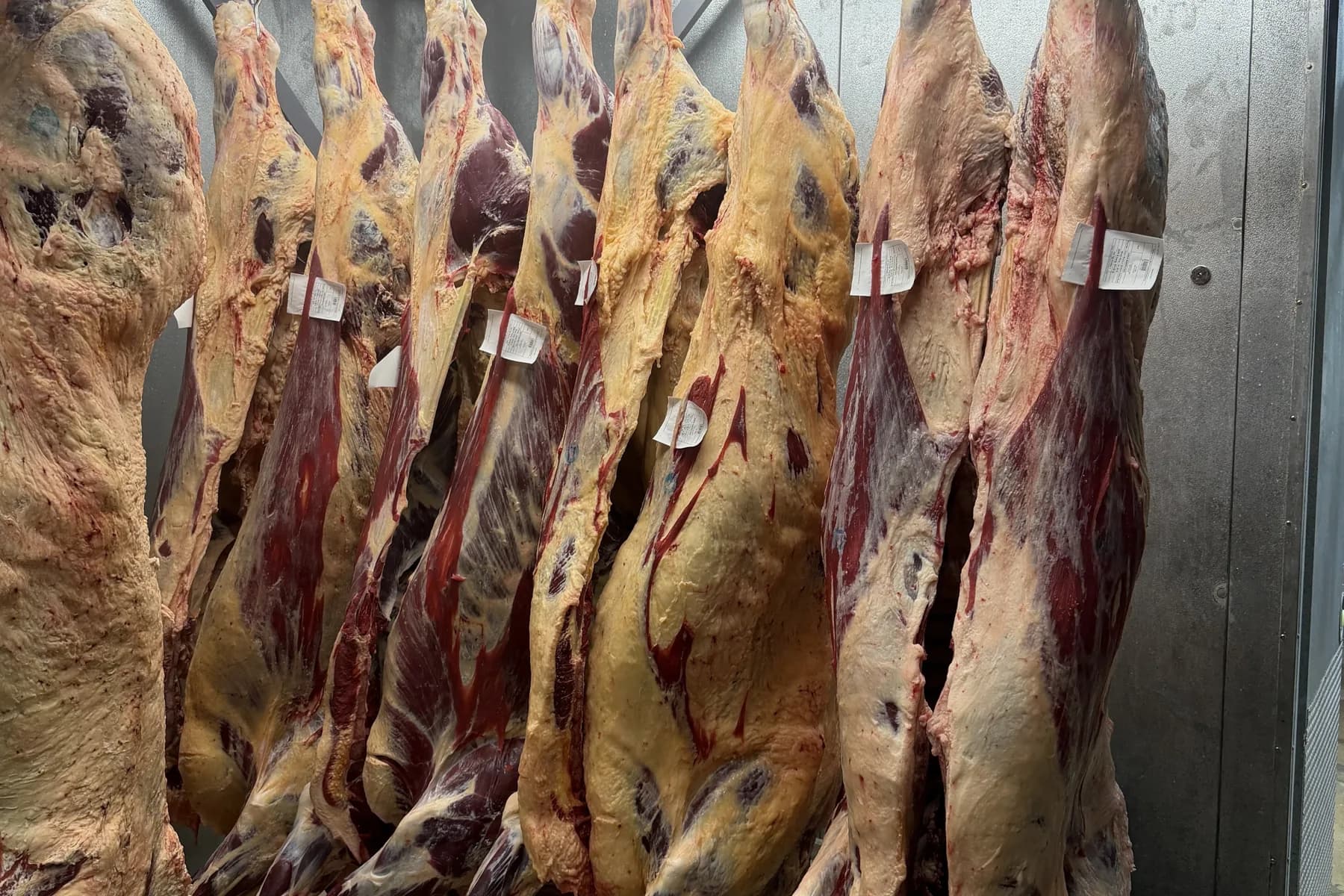
- Hanging weight recorded. The carcass is weighed on the rail. That number goes on your report and is the first of the three weights explained in hanging weight vs. take-home weight.
- Into the chill cooler. The carcass hangs and chills for 72 hours before we start cutting.
The next two to three weeks
After the 72-hour chill, fresh cuts such as ground beef, roasts, ribs, and fajita meat are cut, packaged, and labeled first. Brisket, ribeye, strip loin, tenderloin, sirloin, picanha, and tri-tip are vacuum sealed again and wet aged 14 days, then packaged and added to the rest of the order. That age is most of the wait, and it is the step that makes those steaks tender. How long beef should hang explains why we will not shorten it. Then the beef is cut to your sheet, vacuum sealed, labeled, blast frozen, boxed, and weighed.
Pickup
We text whoever is picking up when the boxes are ready, 2–3 weeks after drop-off. Pickup is at the plant, Monday through Saturday, 10am to 6pm. You get your boxes, frozen and labeled.
Plan for the volume. A half from a 1,200 lb steer is about 215 pounds of frozen packages and fills several large coolers or a truck bed under a tarp. A whole is double. The beef is solidly frozen and travels fine for a couple of hours, but do not leave it in a hot cab for an afternoon of errands.
What to do if something goes wrong
- Animal goes down in the trailer or arrives injured: tell us before you unload. The inspector has to see it, and we will handle it with you.
- You forgot the cut sheet: cut sheets are due at drop-off. Call before you haul if you need help filling one out. We would rather do that on the phone than at the chute.
- You cannot make your date: call, the earlier the better. Slots are tight in fall and after county shows, and a cancelled slot goes to the next family on the list.
- A number on the weight report looks wrong: ask. We would rather explain a report than have you leave wondering.
Ready to book? Call (817) 404-7405 with a rough finish date. The flat fee is $850 whole or $450 half, and it is the same number at pickup.
Read more on Texas beef processing, see flat beef processing prices, and beef processing near Weatherford.