
Two machines package everything that leaves this plant. Steaks and all ground products go through a rollstock machine that forms a package from 6 and 9 mil film, seals it, and then it is labeled. Roasts, ribs, brisket, bones, and organs go into chamber vacuum bags. Every package gets a label with the cut, weight, your name, the date, and the USDA mark. Then all of it is blast frozen and boxed by half. Packaging is included in the flat fee; there is no vacuum-seal upcharge here.
What goes where
| Cut | Format | How it is packed |
|---|---|---|
| Steaks | Rollstock | One steak per package, in 6 and 9 mil film |
| Ground beef | Rollstock | 1 lb packages |
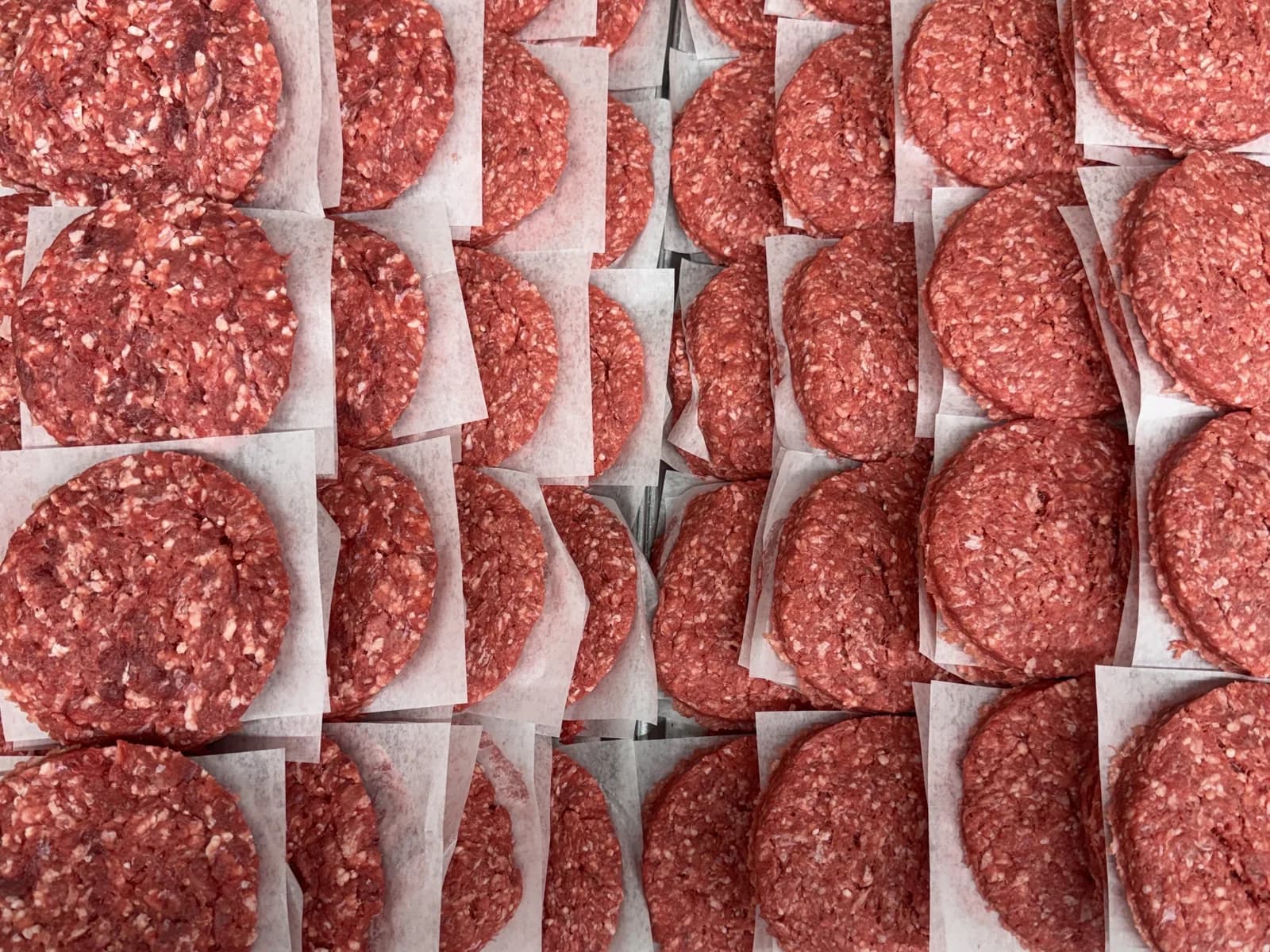
| Patties | Rollstock | 1/3 lb patties, 3 per 1 lb package, in 20 lb lots |
| Chili meat | Rollstock | Coarse grind, 1 lb packages, in 20 lb lots |
| Stew meat and cutlets | Vacuum sealed | 1 lb packages |
| Roasts | Vacuum sealed | Each roast in its own bag, sized as written on the cut sheet |
| Brisket, ribs, tri tip, picanha | Vacuum sealed | Whole or halved as the sheet says, one item per bag |
| Soup and marrow bones | Vacuum sealed | Bagged by the portion |
| Organs and kidney fat | Vacuum sealed | Heart halved, liver sliced, tongue whole, oxtail cross-cut; fat bagged for rendering |
Why the film matters
Most plants run the thinnest film that will hold a seal, because film is a cost per package. Ours is 6 and 9 mil, which is much thicker than the industry average. Three things follow from that.
- No freezer burn. Freezer burn is dehydration through the film. Thick barrier film stops it, so a steak pulled out in month eleven looks like a steak pulled out in month one.
- No punctures. A chest freezer full of beef is a pile of bones and corners. Thin film tears against them; thick film does not. A torn package is the most common reason a family loses beef.
- Clean handling. A sealed rollstock package does not leak in a cooler on the drive home or drip in the refrigerator while it thaws.
The label
Every package leaves with the same five things printed on it:
- The cut name, as it appears on your cut sheet, so “Chuck Roast” is a chuck roast and not a mystery.
- The net weight of that specific package, weighed at packing. This is what adds up to your box weight on the report.
- Your name. Two families splitting an animal get two names on two sets of packages. Nothing is sorted by memory.
- The pack date, so you can rotate the freezer.
- The USDA mark of inspection with our establishment number, 2918. That is what makes the package legal to sell or give away, and it is the same mark that goes on the beef the company sells at retail.
If the beef is for sale under your own brand, the label is built differently, with your name as the brand and the required elements laid out for retail. That is covered on the private label page.
Blast frozen and boxed by half
Packaged beef goes into the blast freezer, which pulls it to frozen far faster than a household freezer can. Fast freezing means smaller ice crystals, less cell damage, and less purge when you thaw. Then the packages are sorted by cut type and boxed, with your name on every box. A half is boxed separately from the other half, so two families can pick up at different times without anyone counting packages in the parking lot.
Pickup is at the plant, frozen. A half is roughly 210 to 230 pounds of packages; bring coolers or a truck bed with a tarp. The boxes and the weight report match: what the report counts is what is in the boxes.
In your freezer
- Plan on up to 12 months at quality. The packaging is an oxygen barrier and the beef was frozen fast, so it holds. Beef is safe indefinitely frozen; quality is the limit.
- Keep it at 0°F or below. A freezer that cycles warm is what shortens the year, not the packaging.
- Thaw in the package in the refrigerator, on a plate. Steaks overnight, roasts a day or two. The sealed package means no drips.
- Rotate by date. The pack date is on every label. Eat the oldest first, which usually means the ground beef.
- Do not refreeze thawed steaks. One steak per package means you never have to.
Included, not extra
Vacuum sealing is a common upcharge at per-pound plants. Here rollstock and vacuum packaging are part of the flat fee, $850 whole or $450 half, along with the labels, the blast freeze, the boxes, and the weight report. Full pricing. Questions about a specific cut? Call (817) 404-7405.
Read more on Texas beef processing, see flat beef processing prices, and beef processing near Weatherford.