
Beef should age at least a week and ideally about two before it is cut. Our standard is a 14-day wet age after the carcass chills, which is why it takes 2–3 weeks from drop-off to pickup. A plant that hands your beef back in four days did not skip a formality. It skipped the step that makes a steak tender.
What aging actually does
Muscle is held together by connective tissue, mostly collagen. After harvest, enzymes that are naturally present in the muscle keep working for weeks, and one of the things they do is break down the proteins that make meat tough. Given time under refrigeration, a chewy cut becomes a tender one. Nothing is added. The beef does it to itself, as long as it is kept cold and given the days.
At the same time, flavor compounds develop. Aged beef tastes more like beef. That is not marketing; it is the same chemistry that makes a two-week steak taste different from a two-day one.
How many days is enough
| Days after harvest | Tenderness | Flavor | Notes |
|---|---|---|---|
| 1 to 3 | Toughest the beef will ever be | Flat, metallic | Rigor has set and only just begun to release. Nobody should cut here. |
| 7 | Noticeably better | Developing | The bare minimum most careful plants will accept. |
| 10 to 14 | Most of the gain is in | Rounded, fuller | The sweet spot for cost, yield, and quality. Our standard is 14. |
| 21 to 28 | Small further gains | Concentrated, nutty if dry-aged | Steakhouse territory. Weight loss and cooler time climb faster than the benefit. |
| 45+ | No further gain | Funky, blue-cheese notes | A specialty product with its own market. Not for a freezer beef. |
Wet aging vs. dry aging
Both methods tenderize the beef the same way, because the enzymes do not care how the meat is wrapped. The difference is what happens to moisture and flavor.
Wet aging
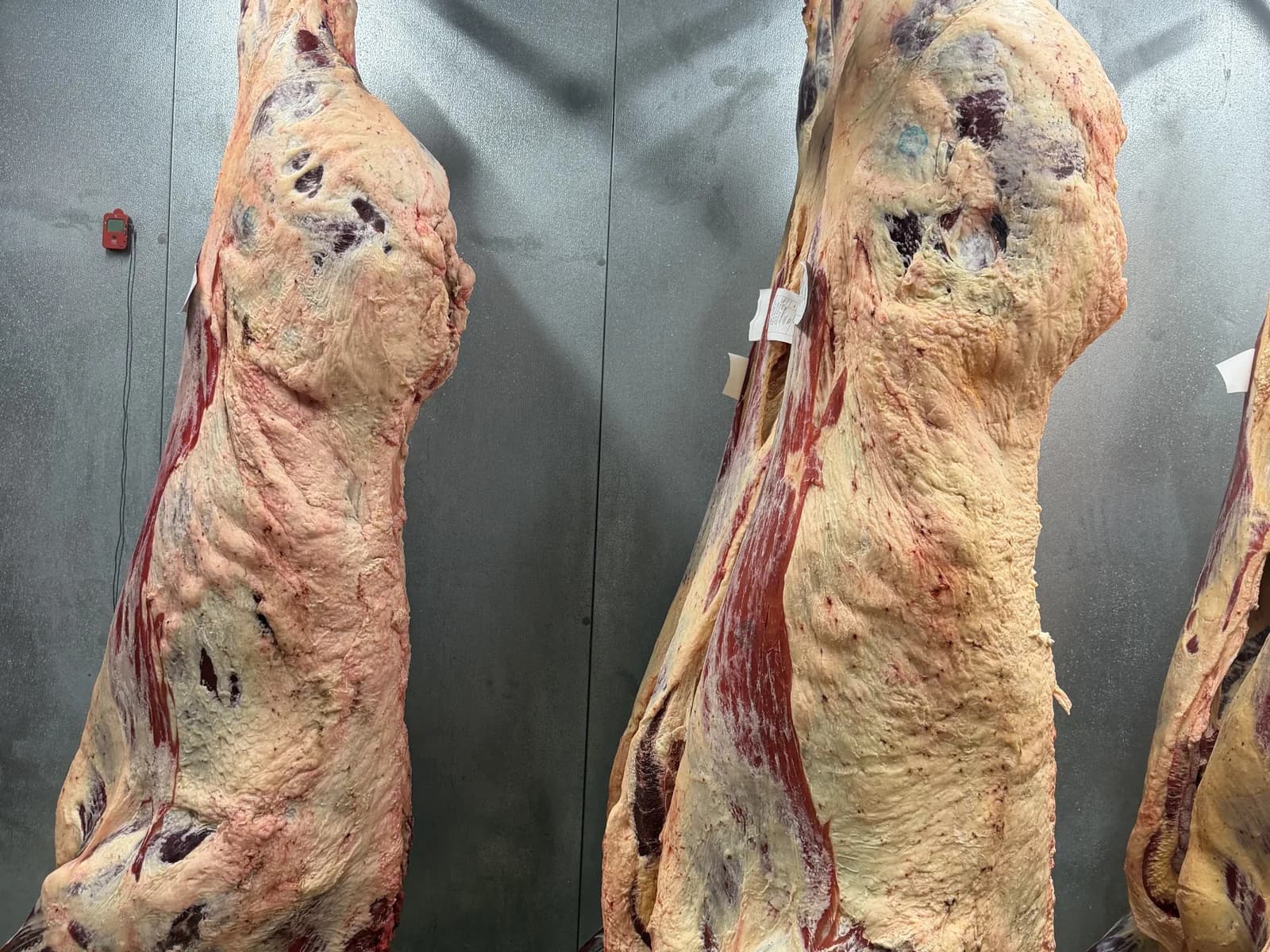
The carcass chills 72 hours. Fresh cuts that do not need aging, such as ground beef, roasts, ribs, and fajita meat, are cut, packaged, and labeled first. Brisket, ribeye, strip loin, tenderloin, sirloin, picanha, and tri-tip are vacuum sealed again and held cold for 14 days. The beef ages in its own juices. Weight loss is small, and the flavor stays clean and beefy. That is our 14-day wet age, as printed on our cut sheet.
Dry aging
The carcass or primal hangs exposed in a cooler with controlled humidity and air flow. Moisture evaporates and a dry crust forms that has to be trimmed away. The result is a concentrated, nutty flavor that steakhouses charge for, at a cost of roughly 10 to 20 percent of the weight and a lot more cooler space and time. For a family filling a freezer, that is a lot of beef to give up for a flavor note that only really shows on premium steaks.
Where the 2–3 weeks goes
- Harvest and inspection, day 1. USDA inspector present. The carcass goes into the chill cooler the same day.
- Carcass chill, 72 hours. The carcass hangs and chills before we start cutting.
- Fresh cuts, then a 14-day wet age. Ground beef, roasts, ribs, and fajita meat are packaged first. Brisket, ribeye, strip loin, tenderloin, sirloin, picanha, and tri-tip are vacuum sealed again and wet aged. This is the part that cannot be rushed.
- Cutting, packaging, freezing, one to a few days. Cut to your sheet, vacuum sealed, labeled, blast frozen, boxed, and weighed for your report.
Add a day or two of scheduling slack on either end and you land at two to three weeks. If we told you ten days, something above would have to be cut short, and it would be the aging.
The four-day plant
You will find processors who promise your beef back within a week. Sometimes that is a plant with excess cooler capacity in a slow month and it genuinely aged for seven days. More often the beef was cut two or three days after harvest. That beef is safe and legal. It is also tougher than the same animal would have been with two weeks in the cooler, and the customer usually blames the animal or the breed rather than the schedule. Ask the question directly: “How many days does the beef age before you cut it?” The answer tells you more about the plant than the price does.
What aging costs you in weight
A little. Wet-aged subprimals give up some purge in the bag. Dry-aged beef gives up much more. Either way the loss is water, and it is one of the reasons your boxed weight is lower than your hanging weight. The full accounting is in hanging weight vs. take-home weight.
Schedule with the aging built in
When you call (817) 404-7405 to book, we give you a drop-off date and a pickup window that already includes the 14 days. If you need beef by a specific date, a holiday or a market, tell us and we will work backward from it. Call (817) 404-7405.
Read more on USDA beef processing in Texas, see flat beef processing prices, and beef processing near Weatherford.